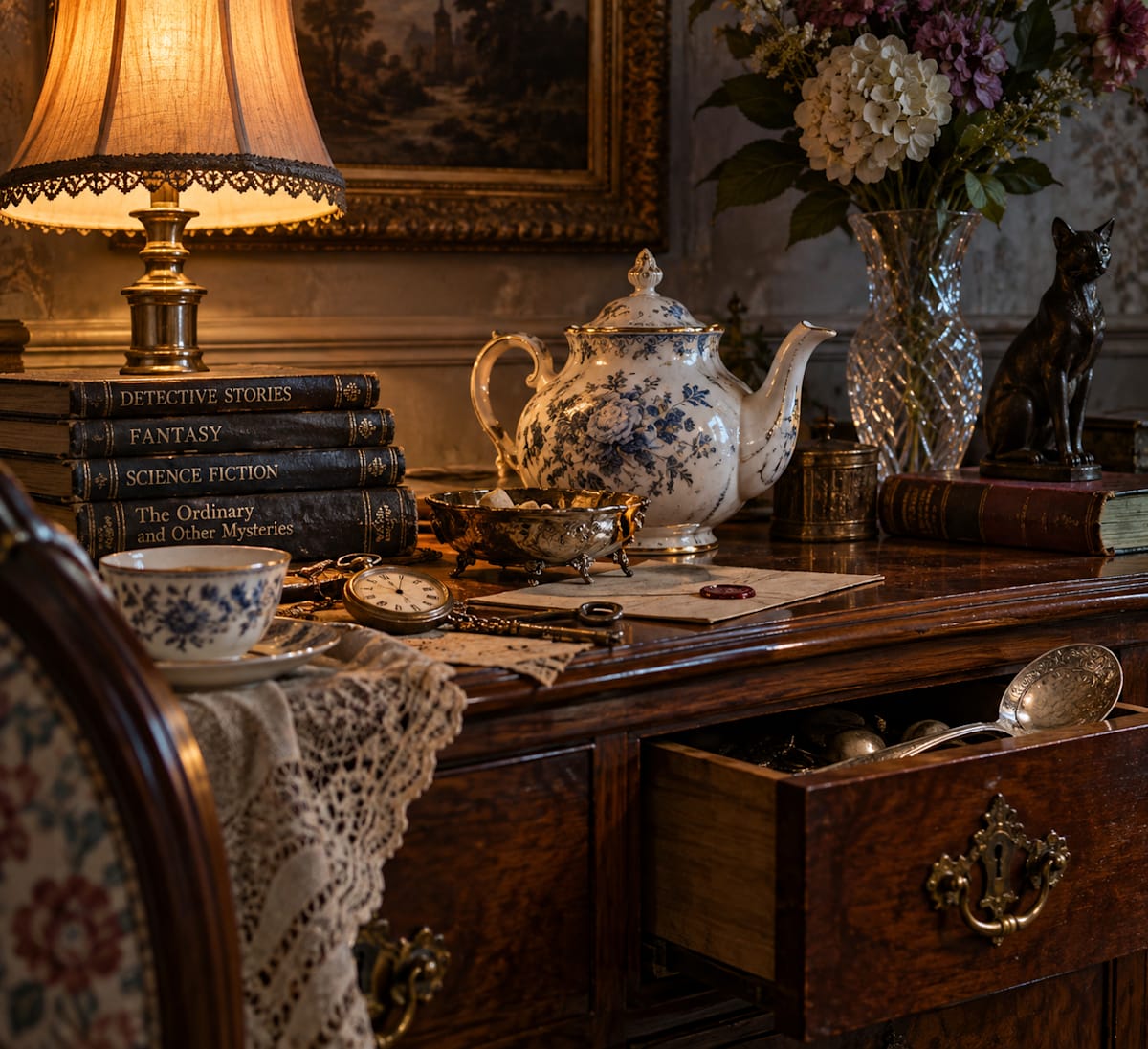
I have never entirely trusted ordinary objects. I don't mean this in a haunted-doll, possessed-toaster way, because that would at least be simple. You could call the right professional, salt something, burn something else, and avoid buying antiques from shops where the owner leans in and whispers that it belonged to her grandmother.
What worries me is different. I mean objects that seem to have accumulated opinions over time. Some chairs clearly resent being sat upon, and some lamps light a room with the enthusiasm of a minor bureaucrat processing a form nobody wanted to file. Every household has at least one drawer that has rejected the entire concept of opening. You pull, and it refuses. You pull harder, and it seems to weigh your request. Then, without warning, it flies open and tries to disembowel you with a serving spoon.
Writers are supposed to observe people, but people already have enough observers watching them. I find myself far more interested in the teapot that has survived three generations and knows exactly who stole the silver.
Salvador Dalí had a name for something rather like this: the paranoiac-critical method. His version was considerably more elaborate, naturally, because this was Dalí. But part of the idea was to look at ordinary reality until other meanings and associations began to reveal themselves. I find this enormously reassuring. Apparently, regarding a household object with unwarranted suspicion is not necessarily eccentricity. It may simply mean one has artistic precedent.
This is probably why I write detective fiction, fantasy, and science fiction in roughly equal measure. All three depend on the same suspicion: that reality keeps presenting itself as perfectly normal while behaving strangely around the edges.
A detective knows the teapot is hiding something. A fantasy writer knows the door is not just a door. A science fiction writer wonders what that drawer would do if it had another hundred years to think about it.
I don't believe imagination requires escaping the ordinary at all. I think it only requires staring at the ordinary long enough for its disguise to slip, which usually takes about thirty seconds, especially where drawers are involved.